
Computing
Computing and Digital Safety Curriculum Intent
Why do we teach our pupils:
Each of our children is a precious and unique individual, with God given talents and abilities, created to fulfil a special role in God’s intricate plan for the world.
‘“For I know the plans I have for you”, declares the Lord, “plans to prosper you and not to harm you, plans to give you hope and a future”.’ Jeremiah 29:11
Why do we teach Computer Science and Digital Safety?
Children have the right to enjoy childhood online, to access safe online spaces, and to benefit from all the opportunities that a connected world can bring to them, appropriate to their age and stage. As they grow older, it is crucial that they learn to balance the benefits offered by technology with a critical awareness of their own and other’s online behaviour and develop effective strategies for staying safe and making a positive contribution online.
Computers are now part of everyday life. For most of us, technology is essential to our lives, at home and at work. ‘Computational thinking’ is a skill children must be taught if they are to be ready for the workplace and able to participate effectively in this digital world.
How will our teaching of Computer Science and Digital Safety enable our pupils to fulfil the plan God has for them?
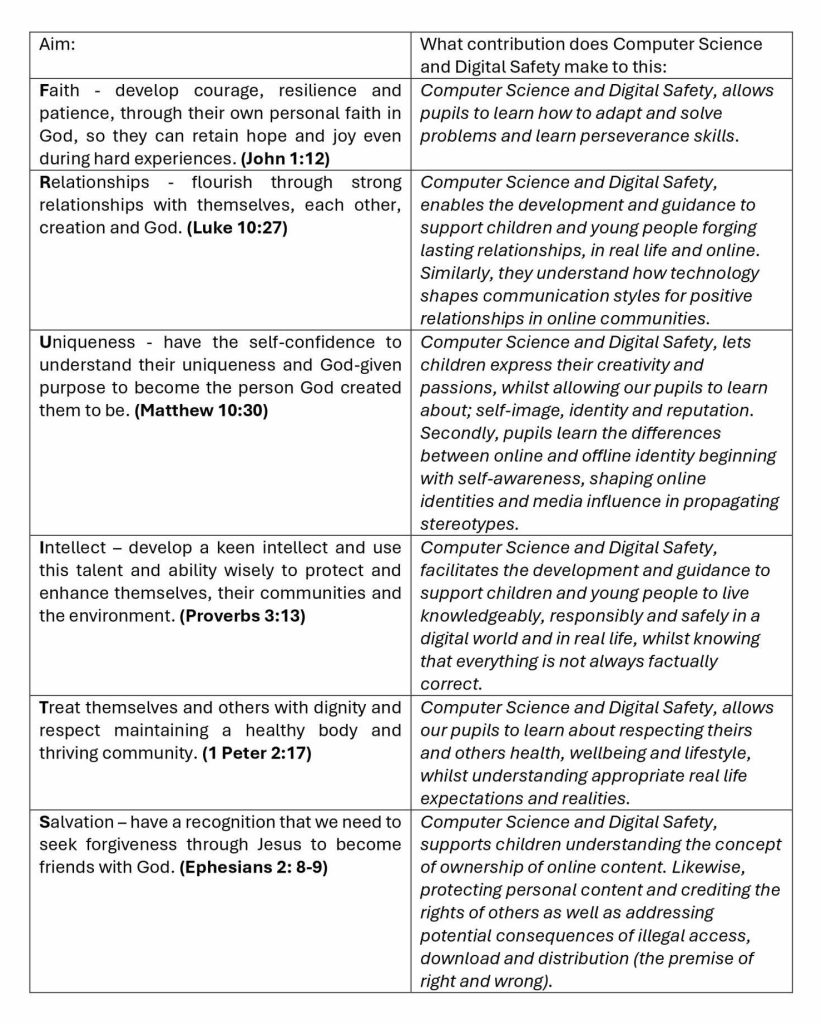
We teach Digital Safety to enable the development and guidance to support children and young people to live knowledgeably, responsibly and safely in a digital world. Whilst allowing our pupils to learn about; self-image and identity; relationships; reputation; health, wellbeing and lifestyle; privacy and ownership.
We teach Computer Science as it allows pupils to learn how to adapt and solve problems, learn perseverance skills and express their creativity and passions. Computing is a skill that empowers and one that all pupils should be aware of and develop competence in.
What do we want to achieve by teaching Computer Science and Digital Safety?
Through the teaching of Digital Safety, we want to broaden the provision of online safety education, so that it is empowering, builds resilience and effects positive culture change. Digital Safety promotes the development of safe and appropriate long-term behaviours, and supports pupils in shaping culture within their setting and beyond.
Through the teaching of Computer Science, we want to ensure to ensure all pupils can understand and apply the fundamental principles and concepts of computer science, including abstraction, logic, algorithms and data representation. Correspondingly, children can analyse problems in computational terms, and have repeated practical experience of writing computer programs in order to solve such problems.
Computer Science and Digital Safety FRUITS


St Leonard’s Primary School uses National Online Safety (NOS) lessons to teach children how to stay safe, responsible, and respectful in the digital world. With technology playing such a large part in pupils’ lives, we believe it is vital to equip them with the knowledge and skills they need to use the internet confidently and wisely.
The NOS curriculum provides age-appropriate lessons that cover topics such as safe online communication, protecting personal information, recognising online risks, managing screen time, and understanding the impact of digital behaviour on themselves and others. Lessons are engaging and practical, helping children to apply what they learn to their everyday experiences both in and out of school.
We are proud that St Leonard’s has held Certified School Status with National Online Safety for multiple years, demonstrating our ongoing commitment to safeguarding children in the digital world. Using NOS also ensures that our staff receive up-to-date training, and parents have access to high-quality resources, so the whole school community can work together to keep children safe online.
By embedding these lessons into our wider curriculum, St Leonard’s ensures that pupils not only develop digital skills but also learn to make positive, thoughtful choices that reflect our Christian values, enabling them to flourish as responsible digital citizens.
Discover what St Leonard’s students are learning — click the blue links below to view our Computing curriculum.
Whole school Computing Evidence
Whole school Computing overview

Computing Progression Of Skills
St Leonards Progression Of Skills 2024 Computing
Computing Assessment
Computing – Assessment – UKS2 Year A
Computing – Assessment – LKS2 Year A
Computing – Assessment – KS1 Year A
Computing – Assessment – UKS2 Year B
Computing – Assessment – LKS2 Year B
Computing – Assessment – KS1 Year B
Computing Medium Term Planning Examples
Computing MTP LEGO Spike Education Prime Spring 1
Osmo Coding Year 3 And 4
Hello Ruby Year 1 And 2
Computing MTP Animation UKS2 Spring 2
Computing MTP Animation LKS2 Spring 2
Computing MTP Animation KS1 Spring 2
Computing Knowledge Organisers
St Leonard’s Digital Safety Knowledge Organiser Year 5
St Leonard’s Digital Safety Knowledge Organiser Year 3
St Leonard’s Digital Safety Knowledge Organiser Year 1
St Leonard’s Digital Safety Knowledge Organiser EYFS
Y5 Programming LEGO Spike Knowledge Organiser
Y3 Programming OSMO Knowledge Organiser
Y1 Programming Hello Ruby Knowledge Organiser
Y5 Animation CGI Organiser
Y3 Animation The Boy The Mole The Fox And The Horse Organiser
Y1 Animation Peter Rabbit Animation Organiser
Computing Adaptive Strategies
Inclusive Strategies In Computing